
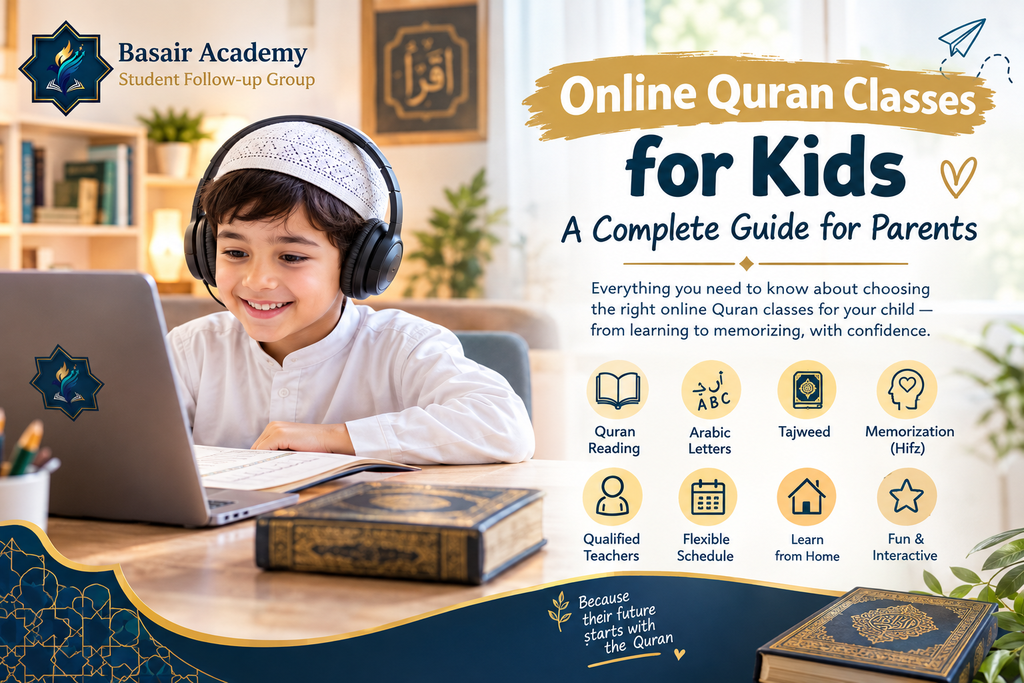
Finding the right Quran education for your child can be challenging.
Many parents want their children to learn the Quran, improve their pronunciation, memorize important Surahs, and develop a lasting relationship with the Book of Allah. But finding the right teacher, teaching method, schedule, and learning environment is not always easy.
This is where online Quran classes for kids can provide a practical solution.
Instead of driving to a Quran center several times a week, children can learn from home through live online lessons with a dedicated Quran teacher.
But how can parents know whether an online Quran class is actually suitable for their child?
This complete guide explains what parents should know before choosing online Quran classes for kids, including how online lessons work, what children can learn, how Tajweed and Quran memorization are taught, how often children should attend, and what to look for in an online Quran teacher.
What Are Online Quran Classes for Kids?
Online Quran classes for kids are live Quran lessons delivered through the internet, allowing children to learn from home with a qualified Quran teacher.
Depending on the child’s age and level, lessons may include:
- Learning Arabic letters
- Quran reading
- Noorani Qaida
- Quran recitation
- Tajweed rules
- Quran memorization (Hifz)
- Revision of previously memorized Surahs
- Daily duas
- Seerah
- Islamic manners and Adab
Unlike prerecorded videos, live online Quran classes allow the teacher to listen to the child’s recitation, identify mistakes, and correct pronunciation immediately.
This is particularly important when learning the Quran because accurate pronunciation and proper articulation cannot always be learned simply by watching videos.
Why Are Parents Choosing Online Quran Classes?
For many families, attending a traditional Quran center can be difficult because of school, homework, work schedules, transportation, and other family responsibilities.
Online Quran learning can make the process more convenient.
1. Children Can Learn Quran From Home
Parents do not need to drive their children to a Quran center several times every week.
The child can attend the lesson from a quiet place at home.
2. Flexible Scheduling
Families living in the United States, United Kingdom, Canada, Australia, and other countries often have busy and different schedules.
Online Quran classes make it easier to arrange lessons around school, family activities, and other commitments.
3. One-to-One Attention
Private online Quran lessons allow the teacher to focus on one student at a time.
This can help the teacher identify:
- Pronunciation mistakes
- Tajweed errors
- Weak memorization
- Reading difficulties
- Areas requiring additional revision
- Problems with concentration
4. Parents Can Follow Their Child’s Progress
A structured Quran learning program should make it easy for parents to understand what their child is studying.
Parents should be able to answer questions such as:
What did my child learn today?
What should my child revise?
What should my child practice before the next lesson?
Clear lesson reports and regular communication can make the child’s progress easier to follow.
At What Age Should a Child Start Learning the Quran?
There is no single age that is perfect for every child.
Some children are ready to learn Arabic letters at a young age, while others need more time before beginning structured Quran lessons.
The important question is not simply:
“How old is my child?”
A better question is:
“What can my child comfortably learn at this stage?”
A young child may begin with:
- Arabic letters
- Letter sounds
- Simple Quranic words
- Short Surahs
- Listening and repetition
As the child develops, lessons can gradually include:
- Quran reading
- Tajweed
- Quran memorization
- Revision
- Islamic manners
- Basic understanding of Quranic meanings
The teaching approach should therefore be adapted to the child’s age, level, and ability.
What Should Children Learn in Online Quran Classes?
A strong Quran learning journey should not be based only on memorizing as many pages as possible.
A balanced program can develop several skills gradually.
1. Learning Arabic Letters
For complete beginners, the first step is learning how to recognize and pronounce Arabic letters correctly.
Children may learn:
- Letter shapes
- Letter sounds
- Letters at the beginning, middle, and end of words
- Joining letters
- Basic vowel sounds
A strong foundation makes later Quran reading much easier.
2. Learning to Read the Quran
Once children understand the basics of Arabic letters, they can begin reading Quranic words and verses.
At this stage, the teacher should focus on accuracy rather than rushing through pages.
The goal should not simply be:
“Finish more pages.”
The goal is:
“Read correctly and confidently.”
3. Learning Tajweed
Tajweed teaches students how to recite the Quran correctly according to the rules of Quranic pronunciation.
Depending on the child’s level, Quran with Tajweed for kids may include:
- Noon Sakinah and Tanween
- Izhar
- Idgham
- Iqlab
- Ikhfa
- Meem Sakinah
- Ghunnah
- Qalqalah
- Madd
- Heavy and light letters
- The rule of Lam in the word Allah
- Makharij al-Huruf
Tajweed should not be taught only as definitions.
Children need to hear the rule, understand it, practice it, and apply it while reading the Quran.
How Does Quran Memorization for Kids Work?
Quran memorization, or Hifz, requires more than repeating a verse several times.
One of the most important principles is balancing:
New Memorization + Revision
If a child continuously memorizes new material without revising older portions, previously memorized Surahs can become weak.
A structured Quran memorization program for kids may therefore include four important stages.
Previous Revision
The child reviews material memorized previously.
New Memorization
The teacher introduces a manageable amount of new Quran.
Recitation
The child recites the memorized portion to the teacher.
Correction
The teacher corrects pronunciation, Tajweed, and memorization mistakes.
Home Revision
The child practices the assigned portion before the next lesson.
This approach allows children to build their memorization gradually while strengthening what they have already learned.
For more practical memorization strategies, read our complete guide:
👉 How to Memorize the Quran Faster: 10 Proven Hifz Techniques
How Many Quran Classes Should a Child Take Each Week?
There is no universal number of classes that works for every child.
The appropriate schedule depends on:
- Age
- Current Quran level
- School workload
- Memorization goals
- Attention span
- Family schedule
- Amount of home practice
For many children, consistency is more important than having extremely long or demanding lessons.
A child may benefit more from regular, manageable Quran classes for children than from an intensive schedule that becomes difficult to maintain.
Parents should ask:
Can my child maintain this schedule consistently for months and years?
Quran learning is a long-term journey.
How Long Should an Online Quran Lesson Be?
Lesson length should depend on the child’s age, level, and ability to concentrate.
Younger children may benefit from shorter, focused lessons, while older children and advanced students may be able to study for longer periods.
A good lesson should not simply measure success by the number of minutes spent in front of a screen.
Children can learn through a combination of:
- Quran reading
- Memorization
- Revision
- Questions
- Recitation practice
- Tajweed exercises
- Interactive activities
- Teacher feedback
The goal is meaningful learning, not simply spending more time online.
How Can You Keep Children Interested in Quran Classes?
This is one of the biggest challenges many parents face.
A child may love the Quran but still become bored during a repetitive lesson.
That does not necessarily mean the child dislikes learning Quran.
Sometimes the teaching method needs to be adapted to the child’s age and personality.
Children often respond well to:
- Challenges
- Games
- Visual activities
- Questions
- Achievable goals
- Positive feedback
- Interactive exercises
- Age-appropriate competition
For example, a Tajweed rule can sometimes be practiced through an interactive challenge rather than explained through a long theoretical lesson.
The goal is not to turn Quran education into entertainment.
The goal is to make learning active, understandable, engaging, and appropriate for the child’s age.
What Makes a Good Online Quran Teacher for Children?
Choosing the right Quran teacher online is one of the most important decisions parents make.
A good teacher needs more than Quran knowledge.
Parents should consider several factors.
Strong Quran and Tajweed Knowledge
The teacher should have strong Quran recitation skills and a solid understanding of Tajweed.
Experience Teaching Children
Teaching children requires different skills from teaching adults.
A teacher should know how to communicate with children at an appropriate level.
Patience
Children make mistakes.
A teacher should correct mistakes without making the child afraid to participate or ask questions.
Good Communication Skills
For non-Arabic-speaking children, the teacher may need to explain instructions and concepts in English.
Adaptability
Every child learns differently.
A good teacher should be able to adjust the lesson when a particular method is not working well for the student.
Consistency
Regular lessons, clear homework, and structured revision can make a significant difference in long-term Quran learning.
How Can Parents Help Their Children Learn Quran at Home?
Parents do not need to be Quran teachers to support their children.
Small daily habits can make a major difference.
Create a Regular Quran Routine
Choose a consistent time for Quran reading or revision.
Keep Revision Consistent
Short, regular practice can be easier for children to maintain than occasional long sessions.
Listen to Your Child’s Recitation
Ask your child to recite what they learned during the lesson.
Encourage Rather Than Pressure
Children respond differently to pressure and encouragement.
A supportive environment can help them develop confidence.
Celebrate Progress
Recognize meaningful milestones such as:
- Completing a Surah
- Improving pronunciation
- Reading more fluently
- Completing a Juz
- Strengthening previous memorization
- Learning a new Tajweed rule
Make the Quran Part of Family Life
When children see the Quran being respected, read, and practiced at home, learning becomes part of their environment rather than simply another weekly class.
What Mistakes Should Parents Avoid?
Parents sometimes unintentionally make Quran learning more difficult.
Mistake 1: Focusing Only on the Amount Memorized
More pages do not always mean better learning.
Accuracy, understanding, and long-term retention matter.
Mistake 2: Comparing Children
Every child has a different learning pace.
Comparing children with siblings, classmates, or friends can create unnecessary pressure.
Mistake 3: Ignoring Revision
New memorization without sufficient revision can lead to weak retention.
Strong revision creates strong memorization.
If your child struggles to retain previously memorized Surahs, read:
👉 Why Do Children Forget the Quran? 7 Common Mistakes Parents Should Avoid
Mistake 4: Choosing a Teacher Only Because They Are Cheap
Price is one factor, but it should not be the only factor.
Parents should also consider the teacher’s Quran knowledge, Tajweed, experience, communication skills, and teaching approach.
Mistake 5: Expecting Immediate Results
Quran learning is a gradual process.
Strong foundations often require patience, consistency, and regular practice.
Online Quran Classes vs. Traditional Quran Classes
Both online and traditional Quran education can work well.
The right option depends on the child and the family’s circumstances.
| Factor | Online Quran Classes | Traditional Quran Classes |
|---|---|---|
| Location | Learn from home | Requires travel |
| Scheduling | Often more flexible | Usually fixed |
| Individual attention | Can be one-to-one | Depends on class size |
| Teacher access | Online | In person |
| Family involvement | Easy to follow from home | Depends on the center |
| International families | Highly accessible | May be more difficult |
| Learning environment | Home-based | Physical classroom |
The important question is not whether one format is automatically better for every child.
The important question is:
Which learning environment allows your child to learn consistently, correctly, and comfortably?
How to Choose the Right Online Quran Academy
Before enrolling your child in an online Quran program, ask the following questions.
Is the class live?
Live lessons allow the teacher to listen to and correct the child’s recitation.
Who will teach my child?
Ask about the teacher’s Quran education, Tajweed knowledge, teaching experience, and communication skills.
Is the program personalized?
A young beginner should not necessarily follow the same lesson structure as an older student who already reads Quran fluently.
How is progress measured?
Parents should have a clear way to understand what their child has learned and what needs improvement.
Is revision included?
For children studying Hifz, revision should be an essential part of the program.
Can the teacher communicate effectively with my child?
This is especially important for children who do not speak Arabic.
Is there a trial lesson?
A trial lesson allows parents and children to experience the teaching approach before committing to a longer program.
What Can Children Achieve Through Consistent Quran Learning?
Every child progresses differently.
The pace depends on:
- Age
- Starting level
- Learning ability
- Lesson frequency
- Teacher quality
- Home practice
- Memorization goals
A child’s journey may gradually develop from:
Arabic Letters → Quran Reading → Tajweed → Memorization → Strong Revision
The journey does not need to be rushed.
A child who learns to read the Quran correctly and develops a positive relationship with it has already built an important foundation.
Online Quran Classes for Kids at Basair Academy
At Basair Academy, we provide live online Quran education for children and adults who want to learn from home with structured instruction.
Our programs can include:
- Quran Reading
- Quran with Tajweed
- Quran Memorization
- Quran Revision
- Arabic
- Seerah
- Akhlaq
- Adab
For children, lessons can be adapted according to age, current level, and learning needs.
The goal is not simply to complete pages.
It is to help students read correctly, improve their Tajweed, strengthen their memorization, and develop consistent Quran learning habits.
Parents who are considering online Quran classes can start with a free trial lesson to experience the learning approach and determine whether it is suitable for their child.
Frequently Asked Questions About Online Quran Classes for Kids
Are online Quran classes suitable for young children?
Yes. Online Quran lessons can be suitable for children when the lesson length, teaching method, and activities are adapted to the child’s age and attention span.
Can my child learn Quran online without knowing Arabic?
Yes. Many children begin with Arabic letters and basic reading skills before progressing to fluent Quran reading, Tajweed, and memorization.
Can children memorize the Quran online?
Yes. Online one-to-one instruction can support Quran memorization through new memorization, regular revision, recitation, and teacher feedback.
How often should my child attend Quran classes?
There is no single schedule for every child. The appropriate frequency depends on age, level, goals, school commitments, and the amount of practice possible at home.
Can non-Arabic-speaking children learn Quran online?
Yes. A teacher who can communicate effectively in English can guide non-Arabic-speaking children through Quran reading, Tajweed, and memorization.
Should parents stay with their child during the lesson?
This depends on the child’s age and independence. Younger children may benefit from parental support, while older children may be able to attend independently.
What should my child learn first?
A complete beginner will usually start with Arabic letters and basic reading skills before progressing to Quran reading, Tajweed, and memorization.
What is the best way to help a child remember the Quran?
Consistent revision is one of the most important parts of Quran memorization. Children should regularly review previously memorized material rather than focusing only on new portions.
Final Thoughts
Choosing online Quran classes for kids is not simply about finding a teacher who can help a child memorize more pages.
It is about finding an educational environment where the child can:
Learn correctly.
Practice consistently.
Receive appropriate correction.
Build confidence.
Strengthen memorization.
And gradually develop a lasting relationship with the Quran.
The right Quran program should fit the child’s age, level, personality, schedule, and learning needs.
And perhaps the most important question for parents is not:
“How quickly can my child finish the Quran?”
but:
“How can I help my child continue learning the Quran for years to come?”
If you are looking for online Quran classes for kids, you can start with a free trial lesson at Basair Academy and discover a learning approach designed around your child’s needs.